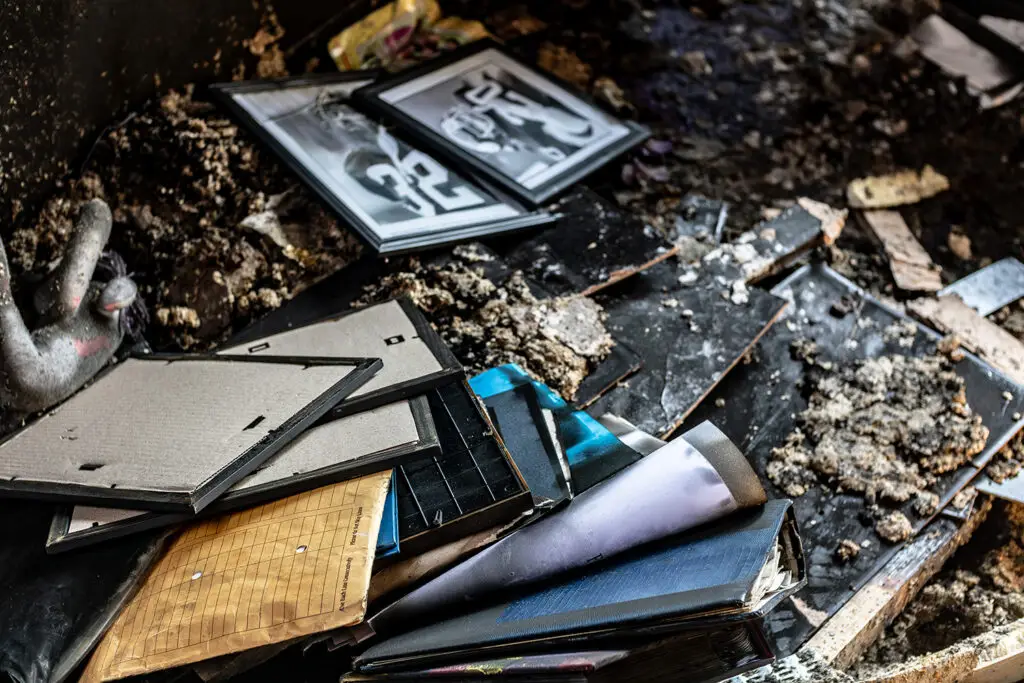
Imagine this: You’re walking through a smoke-damaged home after a kitchen fire. The structure is stable and will likely need some work done, but the contents are another story. In the corner of the dining room, you spot a beautifully carved mahogany dresser that’s charred on one side, but still standing. The homeowner says it belonged to their grandmother.
Now you’re faced with a decision: Is this a total loss, or is it worth restoring?
In restoration work, understanding what qualifies as a total loss is more than just tossing damaged items, it’s about making smart, informed decisions that benefit the homeowner, the insurance company, and your reputation as a contractor.
Table of Contents
- What Is a Total Loss?
- Actual Cash Value (ACV) vs Replacement Cost Value (ACV): What’s the Difference?
- Case Study: A Fire-Damaged 1950s Mahogany Dresser
- When to Total Loss vs. Clean
- Avoid These Common Mistakes
- Why This Matters to Insurance Companies
- How To Deal with Sentimental Items
- Why Contents Should Be Evaluated ASAP
What Is a Total Loss?
A total loss occurs when the cost to clean, repair, or restore an item, such as personal property, vehicles, or structural components, exceeds its current market value. This situation often arises in the aftermath of disasters like fire, smoke damage, water intrusion, or mold contamination. In such cases, the item is deemed economically impractical to salvage, and is classified as a total loss.
Restoration contractors and content specialists play a critical role in identifying total loss items early in the recovery process. Their assessments help streamline the insurance claim, ensuring that damaged contents are properly documented and valued. This early identification is essential for policyholders to receive accurate and timely compensation through their total loss settlement.
“A total loss occurs when the cost to clean, repair, or restore an item, such as personal property, vehicles, or structural components, exceeds its current market value.”
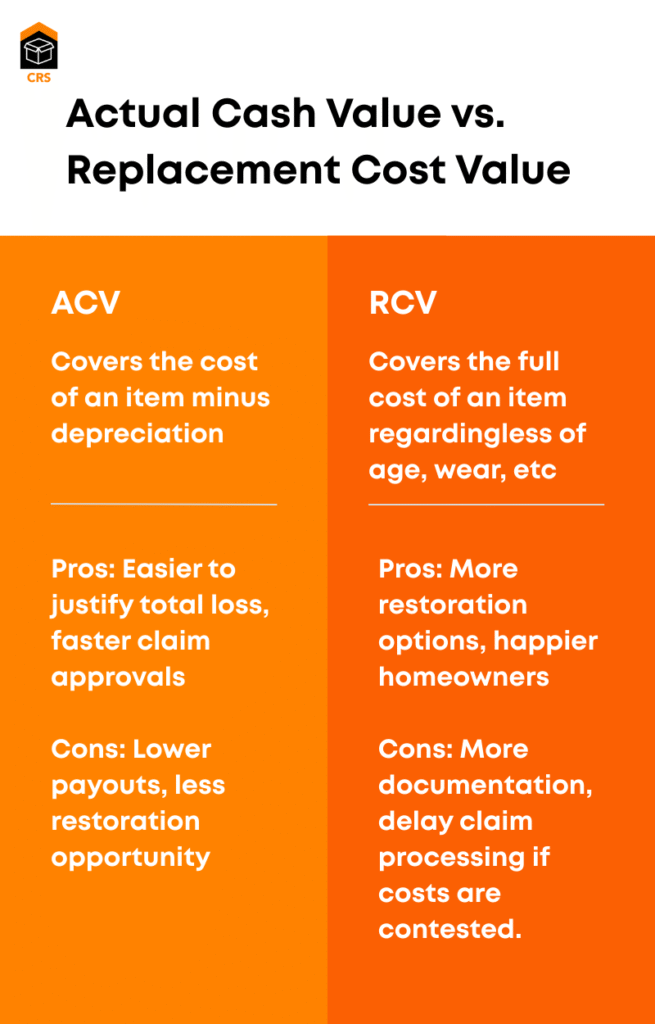
In the context of insurance total loss payout, this designation triggers a specific claims process. When an insured item is declared a total loss, the insurance company typically initiates a total loss claim, which leads to a total loss settlement. An insurance company is going to measure the value of an item within the guidelines of the insured’s policy using two different calculations, called Actual Cash Value vs Replacement Cost Value.
Actual Cash Value (ACV) vs Replacement Cost Value (ACV): What’s the Difference?
ACV
Actual Cash Value is the current value of an item, considering its original cost minus depreciation. Depreciation accounts for wear and tear, age, and reduced usefulness over time.
Example:
If someone bought a laptop for $1,000 three years ago, and it’s now considered to have depreciated by 50%, its ACV would be $500. This is the amount an insurance company might reimburse if the laptop were lost or damaged.
Key Points:
- Reflects the item’s market value at the time of loss.
- Often results in a lower payout than replacement cost.
- Common in auto and property insurance policies.
RCV
Definition:
Replacement Cost Value is the amount it would cost to replace an item today with a new one of similar kind and quality, without deducting for depreciation.
Example:
If that same three-year-old laptop is stolen and a similar new model now costs $1,200, the RCV would be $1,200. This is the amount you’d need to buy a new equivalent item.
Key Points:
- Provides full reimbursement for a new replacement.
- Typically results in a higher payout than ACV.
- Often requires proof of replacement before full payment is made.
Case Study: A Fire-Damaged 1950s Mahogany Dresser
Let’s take a real-world example. A homeowner owns a mahogany dresser purchased for $100 in the 1950s. Fast forward to today: after a fire and smoke event, one side of the dresser is charred and covered in soot. How would insurance handle it?
Policy with ACV
ACV is replacement cost minus depreciation, but with antiques and vintage furniture, carriers typically use fair market value (FMV) instead. For a 1950s dresser, FMV today might be $400–$800. After the $500 deductible, the payout could be very small—or even nothing at all.
Policy with RCV
RCV is what it costs today to replace the dresser with a similar item of like kind and quality. For a mid-century mahogany dresser, that’s about $1,200–$1,500. With a standard $500 deductible, the homeowner would see a payout of roughly $700–$1,000 if the piece is considered a total loss.
Restoration from a Contents Specialists
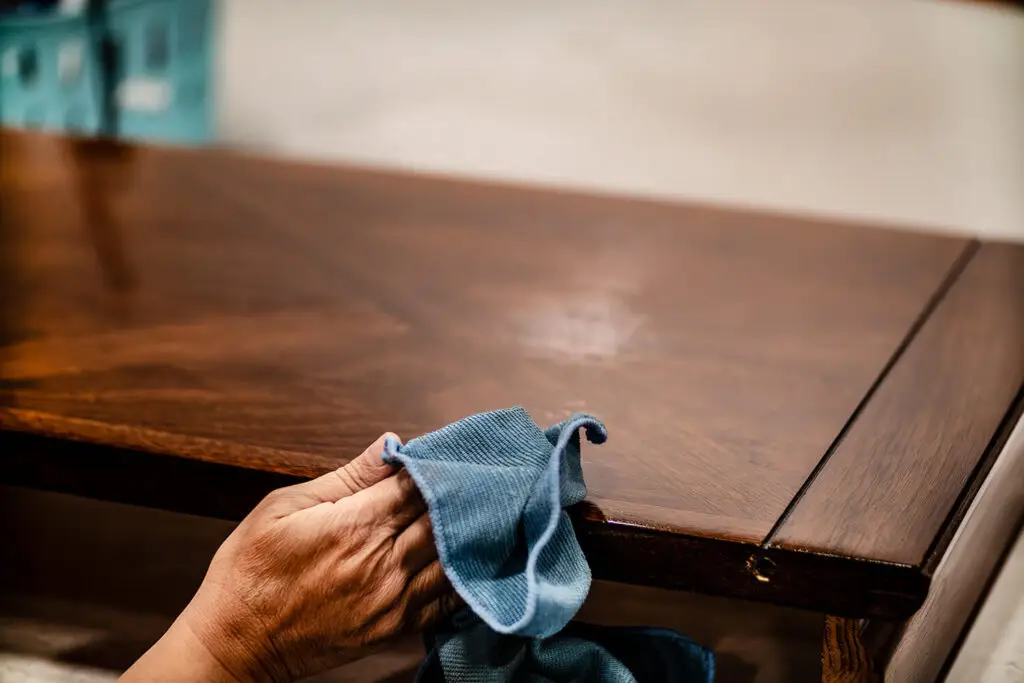
Professional content restoration companies can address the charred panel, smoke damage, and refinishing, with repair costs generally falling in the $800–$1,200 range.
- On an ACV policy, that cost may exceed the insurance payout, leaving the homeowner to cover most of it out-of-pocket.
- On an RCV policy, restoration is a more viable option, since the carrier can reimburse restoration costs (minus deductible) up to the replacement cost value.
When to Total Loss vs. Clean
As a restoration contractor, your judgment directly affects claim costs, timelines, and homeowner satisfaction. Use this checklist to guide your decision-making. If you answer YES to any of these, the item may be worth restoring:
- ✅ Can the item be cleaned or restored using available methods and technology?
- ✅ Does the item hold sentimental or irreplaceable value to the owner?
- ✅ Is the cost to clean and restore less than the value of the item?
- ✅ Was the item affected by fire, smoke, water, soot, or mold—but not beyond salvageable condition?
- ✅ Is the item structurally sound (not warped, melted, or crumbled)?
- ✅ Is the item part of a matched set or collection that would be incomplete if discarded?
- ✅ Is the item made of materials known to respond well to restoration (e.g., hardwood, metal, ceramics)?
Avoid These Common Mistakes
- ❌ Ignoring sentimental value can damage your relationship with the homeowner.
- ❌ Packing out items that are clearly unsalvageable wastes time and resources.
- ❌ Failing to communicate early with adjusters about total loss items can lead to disputes or delays.
Why This Matters to Insurance Companies
Insurance carriers prefer restoration when possible as it keeps claim costs lower and policy premiums more stable. Restoration contractors who understand this can become valuable partners and not just vendors to insurance carriers.

Reputation for Integrity and Efficiency
Restoration companies that avoid overpacking unsalvageable items and communicate clearly about total loss decisions are seen as professional and reliable—qualities insurers value highly.
Lower Claim Costs = Happier Carriers
When you identify items that can be restored instead of replaced, you help reduce the total payout. This keeps the insurer’s costs down and makes your services more attractive for future claims.
Premium Stability for Homeowners
Fewer total loss declarations mean smaller claims, which can help homeowners avoid premium hikes. Contractors who help preserve contents are seen as protecting both the insurer and the insured.
Faster Claim Processing
Clear documentation and smart decisions about what’s salvageable speed up adjuster approvals. That means quicker job completion and faster payment for your team.
Better Relationships with Adjusters
Contractors who consistently make cost-effective, well-justified calls build trust with adjusters. This can lead to repeat business, preferred vendor status, and smoother collaboration on future jobs.
How To Deal with Sentimental Items
Sentimental items—like heirlooms, handmade furniture, children’s artwork, or family photo albums—often carry emotional value that far exceeds their monetary worth. While insurance policies typically don’t reimburse based on sentiment, restoration contractors who recognize and respect this emotional weight can make a lasting impact on the homeowner’s experience.
These items may not be the most expensive, but they’re often the most meaningful. A cracked ceramic vase might be a wedding gift. A smoke-damaged quilt could be handmade by a grandparent. These stories matter—and how you handle them matters even more.
Document everything
Take photos and notes of sentimental items, even if they’re damaged. This helps with insurance discussions and gives homeowners peace of mind that their belongings are being considered thoughtfully.
Offer alternatives
Suggest partial repairs, refinishing, or digital restoration (e.g., scanning damaged photos). Even small efforts can mean a lot.
Communicate clearly
Be honest about what’s possible. Let homeowners know if an item can be restored, partially salvaged, or if it’s truly beyond repair—but do so with empathy.
Ask questions
If you’re unsure whether something is sentimental, ask. A simple “Is this important to you?” can guide your approach and avoid accidental disposal of cherished items.
Why Contents Should Be Evaluated ASAP
Bringing in a contents company before structural restoration offers major benefits:
- Reduces claim costs by identifying total loss items early
- Prevents unnecessary packing and cleaning
- Speeds up insurance approvals
- Improves homeowner satisfaction by prioritizing what matters most
This proactive step helps contractors look efficient and cost-conscious—qualities insurers appreciate.